
Same Earthquake, Same Street: Why One Building Collapses and the Next One Doesn't
Lee este artículo en español → Mismo terremoto, misma calle
For Venezuelans who live far away, the evening of June 24 was spent on the phone — dialing family, waiting for messages, watching the first images come out of La Guaira. I watched them like any Venezuelan abroad, with a knot in my stomach. But I also watched them as a structural engineer. And I kept hearing the same question from friends, clients, and family: why did some buildings collapse while the ones next door stayed standing?
It wasn’t luck, and it wasn’t fate. On more than one street in La Guaira, two buildings raised the same decade, a few meters apart, ended that day one as a pile of rubble and the other without a crack. There is an exact explanation — and the experts now sifting through La Guaira keep pointing to three factors. The unsettling part is that all three had already been written once, in another disaster on this very same coast.
Key takeaways
- Magnitude doesn’t decide who dies. What matters is what the ground does under your building — and near La Guaira, the rupture hit almost point-blank.
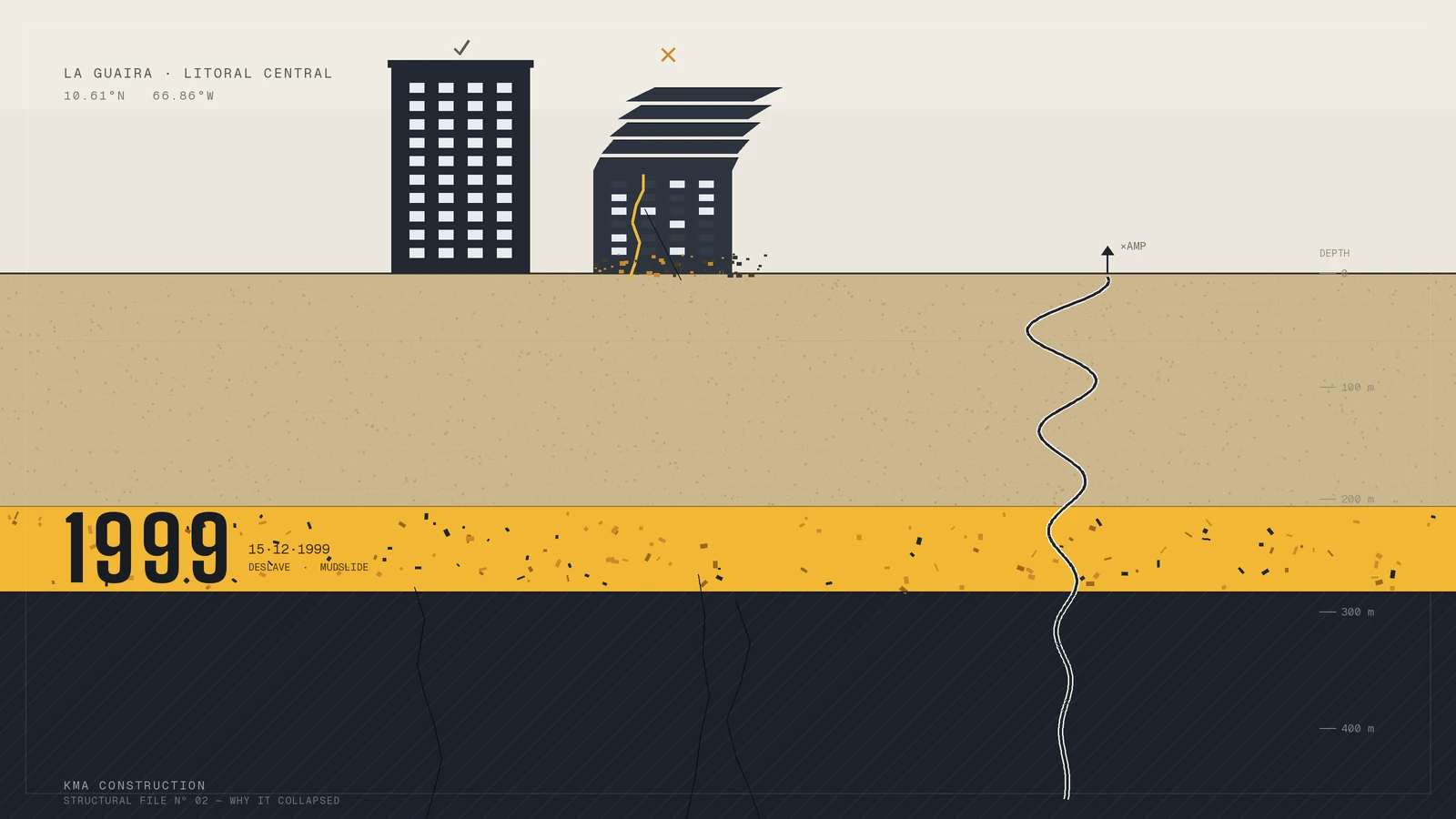
- Soft soil doesn’t cushion a quake; it amplifies it. Much of La Guaira’s soft ground is sediment left by the 1999 Vargas mudslides — and buildings went right back up on top of it.
- When a building falls today, the cause is usually human: how it was built, inspected, and maintained — and whether hard-won lessons were remembered or filed in a drawer.
Factor 1 — The Blow: It Wasn’t the Epicenter, It Was the Rupture
When an earthquake hits, the world learns one number — 7.5 — and assumes it measures danger. It doesn’t. Magnitude measures the energy released down at the fault. What your building actually feels is intensity: how hard the ground shakes under its own foundations, and that can change from one block to the next.
That’s why the epicenters sat in Yaracuy state while the worst destruction landed some 200 kilometers east, in La Guaira. Earthquakes aren’t points; they’re ruptures. This one tore along the San Sebastián fault, which runs the seafloor just off the coast — and the strongest slip, up to 3.6 meters by the Italian INGV’s calculations, happened directly offshore Catia La Mar. “The impact was point-blank,” as civil engineer José María de Viana put it. “The fault doesn’t move the same everywhere,” adds Chilean seismologist Sergio Barrientos; where it slips most, the waves arrive strongest — no matter where the epicenter was. And it was a doublet: two great ruptures 39 seconds apart, magnitude 7.2 then 7.5 — something Venezuela hadn’t seen since 1812.
Factor 2 — The Ground: The Soil That Betrays, and the Ghost of 1999
Here is the rule almost nobody outside the profession knows: firm rock shakes least; soft ground shakes most. Put a bed on a concrete slab and a slammed door barely moves it; put it on a waterbed and the same slam sends you bouncing. Deep, soft sediment doesn’t absorb a seismic wave — it catches it, amplifies it, and keeps it ringing. In 1985, an earthquake more than 320 kilometers away flattened over 400 buildings in Mexico City, because the city sits on the soft bed of an ancient lake.
“Not all soils are equal in La Guaira,” says geophysicist Michael Schmitz. Caraballeda — one of the hardest-hit towns — sits over a sediment basin measured at roughly 400 meters deep. And here is the part that should stop every Venezuelan cold: much of that soft ground is the debris the 1999 Vargas mudslides poured down off El Ávila. Those alluvial fans “acted as a filter that brutally amplified the ground movement,” says de Viana. Ruth Quereguán, a geologist who walked the coast afterward, said it without euphemism: “I saw as much or more devastation than in the deslave.” Same strip of coast, twenty-seven years apart — two overlapping disasters, the second standing on the wreckage of the first.
Soil also explains why, on the same block, a 12-story tower pancakes while the two-story house beside it survives. Every building sways at a natural “note” set mostly by its height — roughly a tenth of a second per floor. When the ground shakes at that same rhythm, each push adds to the last, like a child on a swing, until the structure is asked for more than it has. That’s resonance, and Caracas proved it on July 29, 1967: a modest magnitude 6.6 dropped four 10-to-12-story towers in Los Palos Grandes and Altamira — built over 300-plus meters of soft sediment — while low houses meters away stood untouched. The soil chose its victims by height. And the fault that broke that night was the same San Sebastián system that ruptured on June 24.
Factor 3 — The Hand: How It Was Built, and Who Looked Away
The ground delivers the blow; whether a building survives depends on what’s inside. Collapses happen through a few repeating weaknesses: the soft story (an open ground floor of parking and shops on slender columns — a strong torso on glass ankles); columns whose thin steel hoops, the stirrups, are missing or spaced too far apart, so the concrete shells off and the bars buckle like straws; and the pancake, floor falling flat onto floor, the deadliest failure of all. A well-built structure bends, cracks, and warns you. A badly built one simply snaps.
Engineering has known how to prevent this for decades — ductility, bracing, base isolation. So why do buildings still fall? The cleanest answer came in 2010: Chile’s magnitude 8.8 released about 500 times more energy than Haiti’s 7.0 — yet Chile lost around 500 people and Haiti tens of thousands. The difference wasn’t geology; it was a seismic code, enforced, versus almost none. A study in Nature (Ambraseys & Bilham, 2011) found that 83% of deaths from quake-caused building collapse over three decades happened in unusually corrupt countries. The enemy is often not under the ground. It’s behind a desk.
La Guaira fits the pattern. After 1999, damaged homes were rebuilt and new towers went up on the sediment — but, Quereguán notes, no one can confirm the permits, the materials, or whether soil studies were ever done. Did they follow the seismic code Venezuela adopted after 1967? “We don’t know,” she says — “that’s where negligence and corruption come in.” Foreign rescue teams have described “deficient” materials: beams of expanded polystyrene under a few centimeters of concrete, columns with no steel inside at all.
The Lesson That Was Written Twice
Here is what haunts me. After 1999, Japan’s cooperation agency sent experts who, together with Venezuelan researchers, produced a prevention report for the central coast — delivered, they say, straight into the president’s hands. It named two findings: don’t build in the riverbeds, and adopt rigorous seismic design for the alluvial coastal soil that amplifies the waves. “Nothing was done,” says anthropologist Rogelio Altez, who worked on it. “That report went to a drawer.” Housing for the displaced later rose in Caraballeda over those same riverbeds and sediments. Several of those buildings collapsed on June 24.
That may be the hardest truth: nature isn’t unjust — it’s indifferent. The physics of an earthquake doesn’t distinguish rich from poor. But the way we build does, and the way we remember does. An earthquake simply reveals, all at once and without mercy, decisions made years before, when nobody was watching. Here in Miami our monster is wind, not earthquakes, as I explained in my last article — but Surfside taught us the same rule in 2021: what’s on paper only protects you if it matches what’s in the concrete. That is true in Caracas, in La Guaira, in Miami — everywhere people trust a structure with their lives.
To everyone living the aftermath of June 24 — more than 2,950 confirmed dead as of July 4, with the UN estimating tens of thousands still missing — this is written with respect, and with the conviction that understanding why buildings fail is the only way to keep these mistakes from being repeated. In my next piece: verified ways to help Venezuela from Miami.
This article draws on two excellent Spanish-language explainers — the physics from CONSTRUCTUM and the on-the-ground reporting from BBC Mundo, both worth watching in full — plus interviews with Venezuelan and international experts. All facts independently verified.
If you own property in an older building and want to understand its structural condition, contact us — let’s talk.
Sources: BBC Mundo (Cecilia Barría), “Tres factores…” · CONSTRUCTUM (physics explainer) · Efecto Cocuyo (Rogelio Altez on 1999 → 2026 and the shelved JICA report) · USGS (Rafael Abreu; magnitude/energy, soil amplification) · INGV rupture modeling (3.6 m slip) · De Viana (UCAB), Schmitz (USB/UCV), Quereguán (UCV), Barrientos (U. de Chile) · 1967 Caracas, 1985 Mexico City, 2010 Haiti & Chile earthquakes · Ambraseys & Bilham, “Corruption kills,” Nature 469 (2011) · Surfside 2021