
Why Concrete Rules Miami: A Century of Hurricanes, Building Codes, and Industry Lobbying
Lee este artículo en español → Por qué el concreto manda en Miami
You can read a city’s fears in its walls. In Houston, Atlanta, or Phoenix, most homes are wood-frame — fast, cheap, and perfectly legal. In Miami, almost everything is concrete: block walls in the suburbs, reinforced concrete towers on the skyline, concrete pilings under it all. That didn’t happen by accident. It took a century of hurricanes, one of the toughest building codes in the world, and — yes — a healthy dose of industry politics.
As a civil engineer working in Miami, I get asked some version of this question all the time: does the law force us to build in concrete? The honest answer is more interesting than a simple yes or no. Let’s walk through it.
Key takeaways
- Miami’s preference for concrete goes back roughly 100 years, to the hurricane of 1926 — and it has been written into local codes since 1957.
- The Florida Building Code does not mandate concrete. It sets performance requirements so demanding that concrete became the path of least resistance.
- Wood construction is legal in Miami — even in the High-Velocity Hurricane Zone — if it’s properly engineered. Insurance and market forces, more than the code itself, keep it rare.
- The real lobbying battle today isn’t block versus two-by-fours. It’s mass timber: Florida’s Building Commission declined tall-wood provisions again in December 2025, and the concrete industry holds a statutory voice in how the code is governed.
A Preference Written by a Hurricane
In September 1926, the Great Miami Hurricane tore through a young boomtown. Historical accounts agree on the pattern: wood-frame buildings were flattened by the hundreds, while most masonry and concrete structures — though battered — stayed standing. The lesson stuck. Miami began rebuilding in block and concrete, and local officials started sketching what would become some of the earliest hurricane-conscious building rules in the country.
That’s the short answer to “how long has concrete been Miami’s favorite method”: about a century as a preference, and almost 70 years as written law.
1957: The Code That Made It Official
The law arrived on October 29, 1957, when Dade County adopted the South Florida Building Code. It was, according to Miami-Dade County’s own code history, the first building code in the United States to address hurricane wind loading with an actual engineering formula, developed with the American Society of Civil Engineers.
For the next 45 years, that code governed how South Florida built. It didn’t say “thou shalt use concrete” — but it demanded wind resistance that masonry and reinforced concrete delivered naturally, and it trained generations of local architects, engineers, and contractors to think in block and rebar. An entire regional trade — the shell contractor, who builds a project’s concrete skeleton from foundation to roof deck — grew up around that way of building. Concrete stopped being a choice and became the culture.
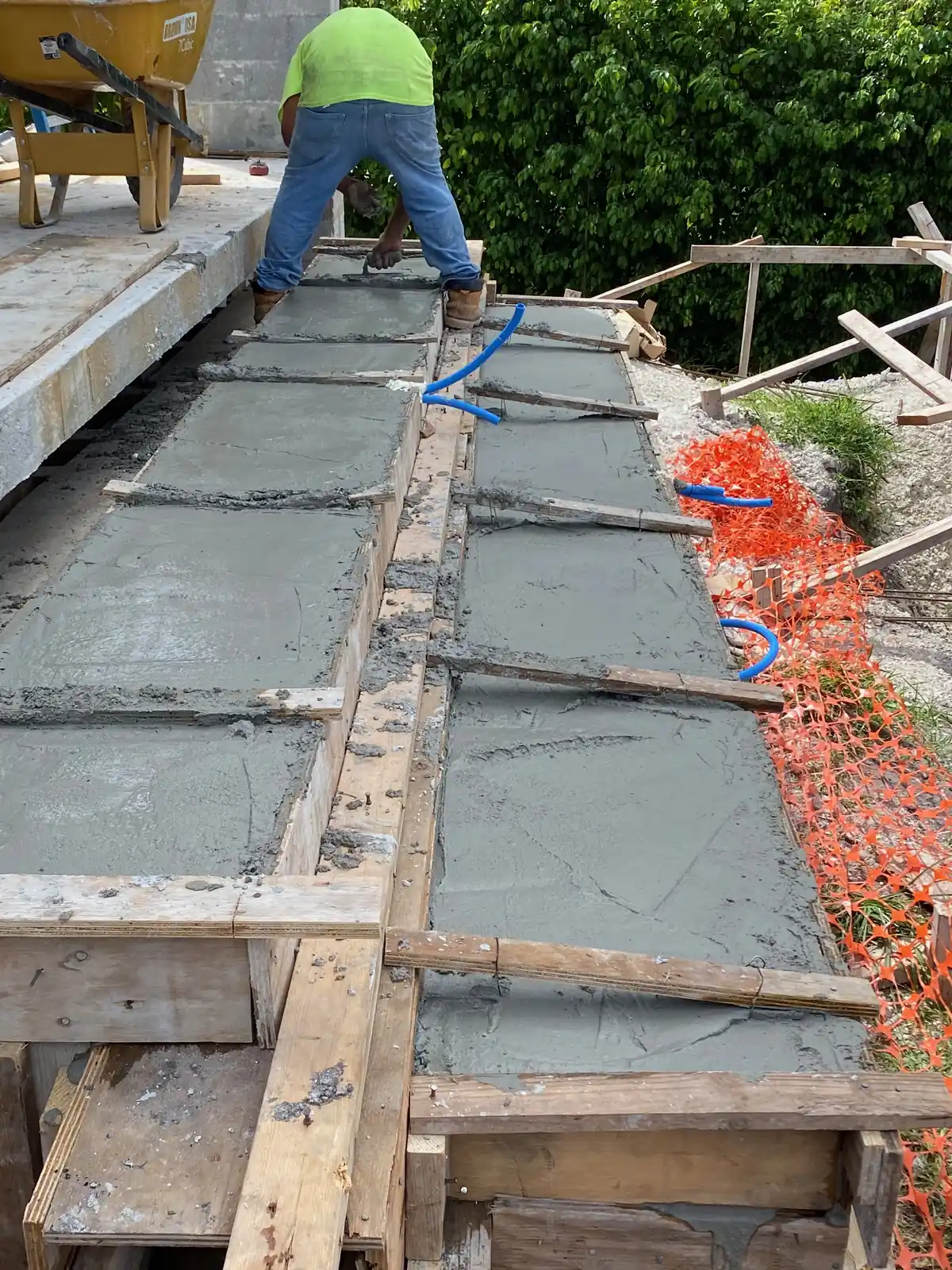 A floating concrete step being finished inside its formwork — the kind of cast-in-place concrete work that defines South Florida sites. Photo: KMA Builder job site.
Andrew: The $26 Billion Stress Test
Then came August 24, 1992. Hurricane Andrew crossed southern Miami-Dade as a Category 5 storm with 165 mph winds. According to the National Weather Service, it destroyed about 49,000 homes, damaged 108,000 more, and caused roughly $26 billion in damage in the U.S. — the costliest disaster in American history until Katrina.
Andrew exposed an uncomfortable truth: the problem wasn’t only what we built with, but how well. Post-storm investigations documented roof sheathing attached with staples instead of nails, missing hurricane straps, and flimsy materials. Studies found that many newer homes actually performed worse than older ones — construction quality had quietly eroded during the boom years while everyone assumed the code had things covered.
The political response reshaped the state. After a study commission in the late 1990s, Florida replaced a patchwork of more than 400 local codes with a single statewide Florida Building Code, effective March 1, 2002. Miami-Dade and Broward kept a stricter overlay: the High-Velocity Hurricane Zone (HVHZ), the toughest wind provisions in the country.
Did it work? The data says yes. A Wharton School study estimated the new code reduced Florida’s windstorm losses by up to 72%, returning about $4.80 in avoided damage for every $1 of added construction cost. After Hurricane Charley in 2004, the Insurance Institute for Business & Home Safety found homes built under the new code had 60% fewer claims, and the claims that did occur were 42% less severe.
Does the Code Actually Require Concrete? No — and Yes
Here’s the part most people get wrong, including some builders: nowhere does the Florida Building Code mandate concrete. The code is performance-based. Any material — wood, steel, concrete, even newer systems — is legal if the engineered design meets the requirements.
But look at what those requirements are in the HVHZ. Structures in Miami-Dade must generally be designed for ultimate wind speeds around 175 mph (the exact value varies by location and building type). Every exterior opening — windows, doors, garage doors, skylights — must be impact-rated or protected. Products need a Miami-Dade Notice of Acceptance (NOA), which means passing the famous large-missile test: a 9-pound 2x4 fired at the assembly at 50 feet per second, followed by 9,000 cycles of positive and negative pressure. The whole county is treated as open, exposed terrain for wind design. No credit for sheltering.
Wood frame can absolutely be engineered to survive that gauntlet — the code’s wood chapter includes HVHZ-specific provisions, and well-designed wood buildings exist here. But concrete’s mass and stiffness get you there with less complexity, fewer failure-prone connections, and a local workforce that has poured and blocked for three generations. Add South Florida’s termites and humidity, which punish wood over decades. Add insurance: industry estimates commonly put premiums for masonry construction 15–35% below comparable wood-frame in Florida (insurers price the same physics the code does). Add lenders, appraisers, and buyers who simply expect block.
So no, the code doesn’t name concrete. It describes a fight that, in practice, concrete is usually the cheapest one to win. That distinction matters — because it tells you where the real influence game is played.
The Lobby: Who Shapes the Rules?
Construction codes look technical and neutral from the outside. They are also, everywhere in the world, negotiated documents — and Florida is no exception.
Start with governance. The Florida Building Code is maintained by the Florida Building Commission, 19 members appointed by the governor. The seats are defined by statute, and they largely belong to industry: builders, contractors, architects, engineers, insurers, product manufacturers. Florida law (Section 553.74) even names the Florida Concrete & Products Association among the groups that recommend candidates for the building-products seat. The concrete industry isn’t knocking on the code’s door from outside; it has a chair in the room, by law. To be fair, so do other industries — that’s how Florida chose to structure it — but it’s worth knowing who’s at the table.
Nationally, the material wars are open and well documented. The concrete industry’s “Build With Strength” campaign, run by the National Ready Mixed Concrete Association, has published activity reports with titles as direct as “Stopping Wood Through Building Code Advocacy,” backing measures in places like New Jersey and Philadelphia to restrict light wood-frame construction in mid-rise buildings. (I found no documented Build With Strength campaign inside Florida — here, frankly, concrete doesn’t need the help.)
The wood industry lobbies just as hard in the other direction. The American Wood Council won approval for mass timber — engineered heavy-wood structural systems — up to 18 stories in the 2021 International Building Code, provisions now adopted in some 44 states. Florida is one of the holdouts. A state technical committee declined to bring tall mass timber into the 2023 Florida Building Code, and in December 2025 the Building Commission declined again for the upcoming 2026 edition — even though, by the wood council’s count, 22 of its 29 proposals had won support at the technical-committee level. The AWC blames “competing material interests and misleading testimony.” That’s their side of the story, and the concrete and masonry associations would tell it differently — but nobody disputes that both sides show up to those hearings with lobbyists.
One more episode shows how political the code really is. In 2017, the Legislature changed how Florida updates its code: instead of automatically adopting each new edition of the international model codes as the baseline, Florida now picks and chooses its own updates. Builder groups supported the change as a way to avoid unnecessary cost; the Building Officials Association of Florida and resilience advocates opposed it, warning it risked drifting back toward pre-Andrew complacency. Watchdogs still rate Florida’s code among the nation’s strongest — first place in the insurance institute’s state rankings in 2018, narrowly second in 2024 — but the episode is a reminder: every line of that code is somebody’s negotiation.
⚙ Engineer’s Note
Clients ask me for the official percentage of concrete-block homes in Miami-Dade. Here’s a secret: that statistic doesn’t exist. The Census tracks exterior siding, not what holds the house up. My field data is simpler — drive any residential street from Hialeah to Palmetto Bay and count the wood-frame houses. You won’t need many fingers. And many of the block homes you’ll pass were built in the 1950s and are still doing their job after a dozen hurricanes. That’s not marketing. That’s performance you can inspect.
An Engineer’s Verdict
So: is concrete king in Miami because of physics, or because of politics?
Mostly physics — and economics that follow the physics. Concrete earned its place across a century of storms, and the data since 2002 shows Florida’s performance-based code delivering exactly what it promised. When a material wins on merit, insurance discounts, and workforce depth all at once, you don’t need a conspiracy to explain it.
But “mostly” is doing some work in that sentence. When one industry holds a statutory role in code governance, and a competing system with technical-committee support can’t get adopted edition after edition, it’s fair to ask whether Miami’s rulebook is protecting people or also protecting market share. Both can be true. As an engineer, my loyalty is to the load path, not to any material’s trade association — and mass timber’s track record elsewhere has earned it a serious, evidence-based hearing in Florida, especially outside the HVHZ.
For now, if you’re building in Miami: build concrete, build it well, and hire people who understand why the code asks what it asks. The next edition of the Florida Building Code takes effect December 31, 2026. I’ll be reading it so you don’t have to.
Planning a project in South Florida, or need to understand the structural side of an existing building? Request an estimate — let’s talk.
Sources: Miami-Dade County Building Code History · NOAA/National Weather Service (Hurricane Andrew) · FLASH, “The Case for Preserving Florida’s Building Code System” (2017), citing Simmons & Czajkowski (Wharton) and IBHS · Florida Statutes §553.74 · NRMCA Build With Strength activity reports (2019) · American Wood Council 2025 Annual Report · IBHS “Rating the States” (2018, 2024) · Miami-Dade Product Control (NOA/TAS standards)